
Bella
- A healthy weight
- Daily walks
- Teeth brushed at home
- No chronic condition on record
- Seen twice a year or more
Working it out…
Companion Health
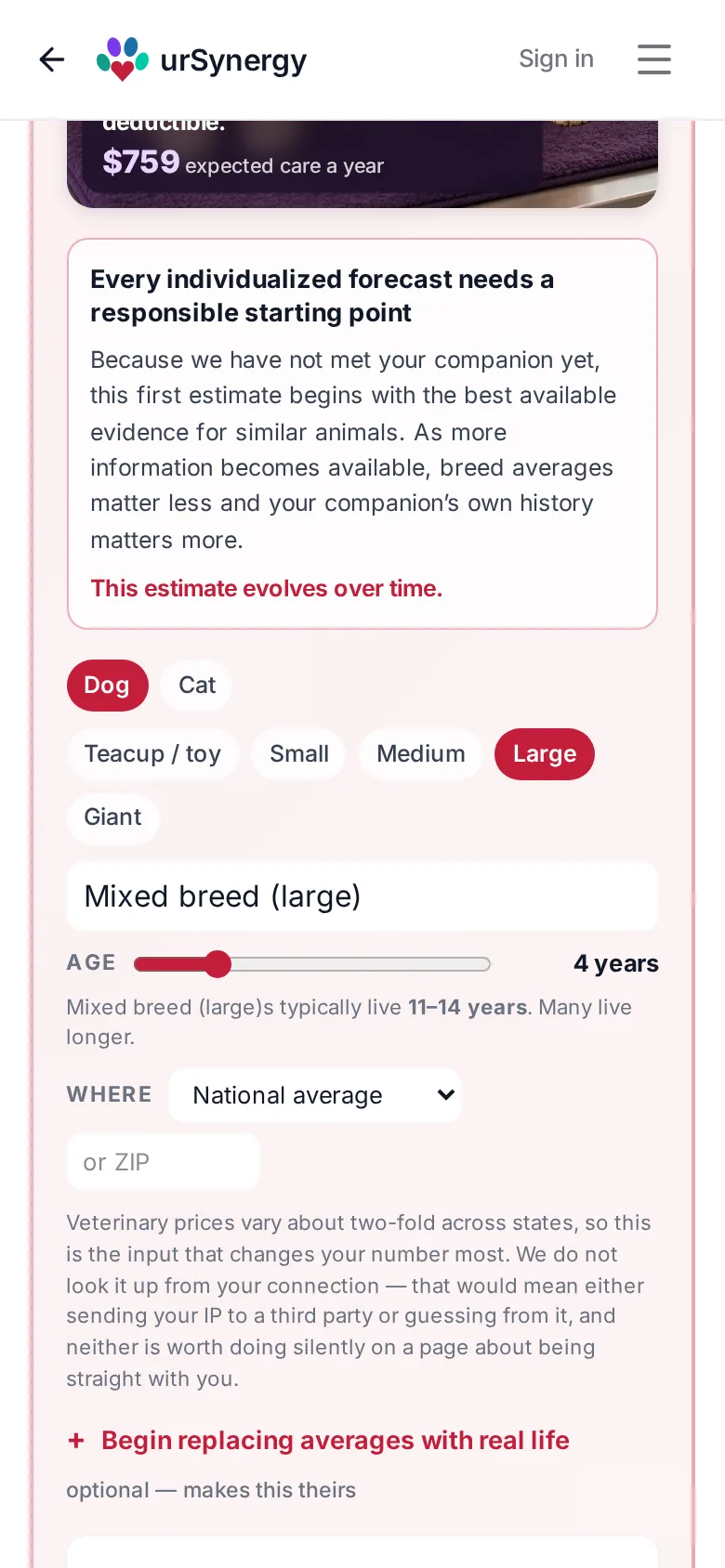
Insurance companies price pets by broad category: breed, age, sex, ZIP code. Companion Health starts there too — only because on day one that is all anyone knows.
As your companion’s records, lifestyle, nutrition, veterinary history, laboratory results, medications and actual healthcare costs become available, those generic assumptions are progressively replaced by information unique to your animal.
Not what animals like yours may cost. What your animal is most likely to need.
And because it is a target rather than a premium: instead of paying premiums, pay yourself.

Veterinary prices vary about two-fold across states, so this is the input that changes your number most. We do not look it up from your connection — that would mean either sending your IP to a third party or guessing from it, and neither is worth doing silently on a page about being straight with you.
These details separate your companion from thousands of others with the same breed, age and size. Every additional fact makes the forecast more specific to them.
Build
Changes the estimate. Extra weight brings joint disease and, in cats, diabetes.
On a usual week
Does not change the yearly figure — it changes which single big bill is most likely.
What they chew
Changes the estimate a little. Chewing and brushing slow gum disease, which stretches the gap between cleanings under anesthetic.
Seen by a vet
Does not change the estimate at all — only how tightly we can draw the range around it.
Large, 4 years · national
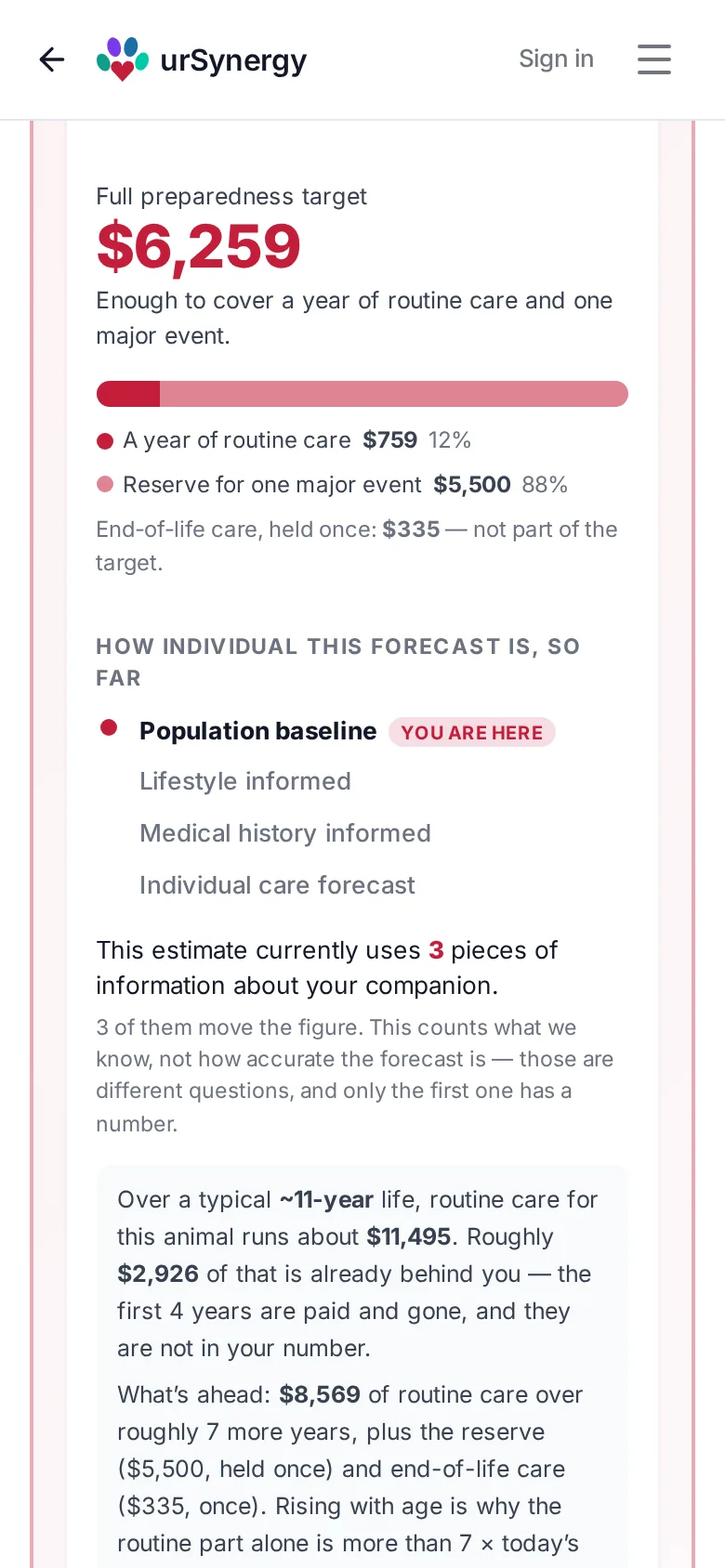
Full preparedness target
—
Working it out…
How individual this forecast is, so far
This estimate currently uses 3 pieces of information about your companion.
3 of them move the figure. This counts what we know, not how accurate the forecast is — those are different questions, and only the first one has a number.
Move the slider to whatever you can manage.
There is no minimum and no wrong answer. Whatever is in the account is that much less to find on the day — if the bill is $100 and you have $40, you need to find $60, not $100.
An estimate, not a promise, and financial planning rather than a medical opinion. Breed, age and location are the starting inputs — the ones we have before we know your animal. Everything you add after that moves the figure off the average and onto them.
On a phone
Traditional insurance predicts costs for groups. Companion Health predicts costs for individuals. That is the whole difference, and it shows up in the question each one is built to answer.
Insurance asks
“What do Labradors usually cost?”
A rate class — breed, age, sex, postcode — set at underwriting and applied for life. Nothing you go on to learn about your own animal moves your premium toward them.
Companion Health asks
“What is Bella most likely to need over the next five years?”
The same population evidence on day one, then replaced piece by piece as her own record fills in. The starting point is shared; the destination is not.
We start with what is known about animals like yours only until we know enough about yours.
Same breed, same age, same country. Most insurers would put these two dogs in essentially the same pricing class, because breed, age, sex and postcode are what a rate class is made of. Below is what our model returns for each of them once five facts about how they live are added — and those five facts are the shallowest layer of individualization there is.
Bella
Working it out…
Charlie
Working it out…
These two forecasts part ways on lifestyle alone, which is as far as an anonymous calculator can go. Orthopedic history, allergy diagnoses, laboratory results and what each dog has actually cost are not inputs this page accepts — they are what connected records add, and they are where the two lines separate properly. Both figures are estimates from the same model used at the top of this page, not predictions about any real animal.
Two dogs with identical breed, age and ZIP code can experience dramatically different healthcare costs. The average was never wrong about the population — it was only ever a statement about the population, and neither of those two dogs is one. Companion Health is designed to learn the differences.
Genetics
What this individual inherited, which a breed average only describes in aggregate.
Nutrition
What they are fed, how much, and for how long.
Weight
The single lifestyle factor with the clearest documented link to joint disease and, in cats, diabetes.
Environment
Indoors, outdoors, traffic, other animals, climate.
Preventive care
Vaccination, parasite control, dental work done on schedule rather than in response.
Previous illness
What has already happened is the strongest available signal about what happens next.
Activity
A sport dog and a sofa dog do not meet the same injuries.
Medications
What they are on, what it is for, and what it needs monitoring for.
Veterinary history
Every visit, result and decision already recorded somewhere.
Not all of these reach the calculator today — several arrive only with connected records, and the ones that do not are named as such wherever they appear. The design is that each of them eventually replaces a piece of the average rather than being added on top of it.
An insurance premium prices your animal by its rate class — breed, age, postcode — and goes on doing that for life. Nothing you learn about your own companion moves the number toward them. This works the other way round: the estimate starts as a breed average and is replaced, piece by piece, by what actually happens to your animal. The two readings below are the live state of that for the animal selected above.
Living Care Forecast
A Living Care Forecast begins with population evidence and becomes more individualized with every verified piece of information added across your companion’s life. It is not a one-off personalization step — it is a continuously improving model of one specific animal.
Information that gradually replaces assumptions
Most of that list is ahead of us rather than behind us. Today the calculator reads species, breed, age, location and what you tell it about how your companion lives; the rest arrives as records connect. Nothing on this page is a medical opinion or a diagnosis — it is financial planning, and your vet decides what care is actually needed.
Personalization is not a switch. It accumulates, and every step below moves weight off the breed average and onto the animal.
Registration
You tell us the animal exists.
Population estimate
Species, breed, age, location. The starting point.
Lifestyle information
Build, activity, environment, home dental care.
Medical records connected
History from the practices that have already seen them.
Veterinary visits
Each new consultation, recorded as it happens.
Lab work
Bloods, urinalysis, imaging — measured values, not assumptions.
Healthcare history
Diagnoses, medications, procedures, and what they actually cost.
Individual Care Forecast
Their own history, weighted above the average that started it.
Steps beyond the lifestyle questions need an account and connected records. Signed in, the forecast for your own animals already uses their recorded veterinary costs once there are at least two priced visits a year or more apart. No animal has that much priced history yet, so today every forecast is still the starting point plus what you tell it.
Individual, not average
The first figure comes from animals like yours, because that is all anyone knows on day one. From there it moves onto yours — every fact you add, and every record that connects, replaces a piece of the average.
Affordable
A monthly amount that fits your life and your budget. Partial participation is a success, not a failure.
Gets better
What you still need to find falls as your balance grows, and whatever you have not spent stays yours. A premium rises every year your animal ages and credits nothing you have already paid.
We get to know your animal
Species, breed, age and location to begin with. Then how they live, what their records show, and what care has actually cost.
We run the math
We begin with the same population evidence insurance companies use. Then, as your companion’s own history grows, generic assumptions are progressively replaced by facts unique to them.
You choose what you can afford
Weekly, every two weeks or monthly, and you can change it.
You build balance and get ahead
The target drops as you progress.
You are ready for it
Use it for what matters, at any practice, with no claim to file.
The figures above are computed for the animal selected at the top of this page, from the same model the calculator uses. Insurance figures are the published market average for a dog at a $250 deductible and 80% reimbursement.
Insurance predicts the future with averages, and it is not wrong to — an average is the right tool for pricing a population. It is simply not a statement about your animal, and it never becomes one.
Companion Health begins with averages because on day one there is nothing else. The whole point of what follows is to stop needing them.
We start with what is known about animals like yours only until we know enough about yours.